
Shannon Moore
Professional Teaching Portfolio
Applied Behavior Analysis
When I began working with one of my students with Autism during the 2013-2014 school year, I noticed that she had limited verbal abilities and rate of acqusition of new material; therefore, she was struggling in her classroom work. At the time she was only in the first grade and the other teachers just thought she needed more exposure to the grade level curriculum and she would eventually get it. I knew it was something bigger and that repeated exposure to the grade level curriculum was not going to help her. My goal was to help her master those fundational skills and find a way to increase her retention rate. I knew about Applied Behavior Analysis from my special education course work, but I had never been formally trained. As I began seeking out professional insight from college porfessors and colleagues, they were able to get me in contact with PaTTAN's Autism Initiative for ABA.
In the summer of 2014, I attended the Level 1 training where I learned about the VB-MAPP, the different operants of communication, and how to use intensive teaching during instruction. I was also told that I would be given monthly consultation throughout the school year to support my students and I.
When I returned to school the next year, I quickly began assessing my student, who was now in the second grade, using the VB-MAPP. At eight years old, she was scoring at the verbal level of a 2 and a half year old. She was not able to identify simple everyday objects, which I had already known, but seeing it in the pre-assessment was eye-opening. Not only was this data important for me to better understand my student, but her parents were so thankful that they had more information regarding their student and, without hesitation, told me to begin the program. With the support of the family and consultants, I got to work on intensive teaching.
I collected data and made data based decisions. I started to see progress with my student, but most importantly, she was so proud of herself because she knew she was getting better at communication! While she was still included in the general education classroom for a portion of her day, I didn't want her to feel unsuccessful in that setting. I collaborated with her general education teacher and instructed her on some procedures and routines she could do to increase this student's participation while in the classroom. She reported back to me that it was amazing and our student was focused and feeling successful.
At least two teachers or administrators a day find me to tell me how impressed they are with her progress and how they cannot believe she is communicating and initiating conversation. Her parents are beyond happy with her progress as well! They cannot believe how she is able to talk about her day and ask for things appropriately at home. We have a great system for communication that I share with her parents daily her progress.
Below are some pictures of the program, the organization, and my data collection to support this student.
VB-MAPP
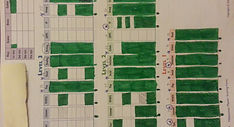
Here is a picture of my student's VB-MAPP at the beginning of the school year. This shows that she is performing around the language level of a 2 and a half year old.
This is the student's progress in one of the operants. She was making such great progress that we moved her mastery from 3 days to 2 days. This helped us cover more material and since she was able to handle it, it only made sense!
Card Sort
After assessing the student using the VB-MAPP, I was able to create the card sort. When instructing, I present knowns ("easies") and unknowns ("hards") at a variable ratio based on her abilities.
